TL;DR
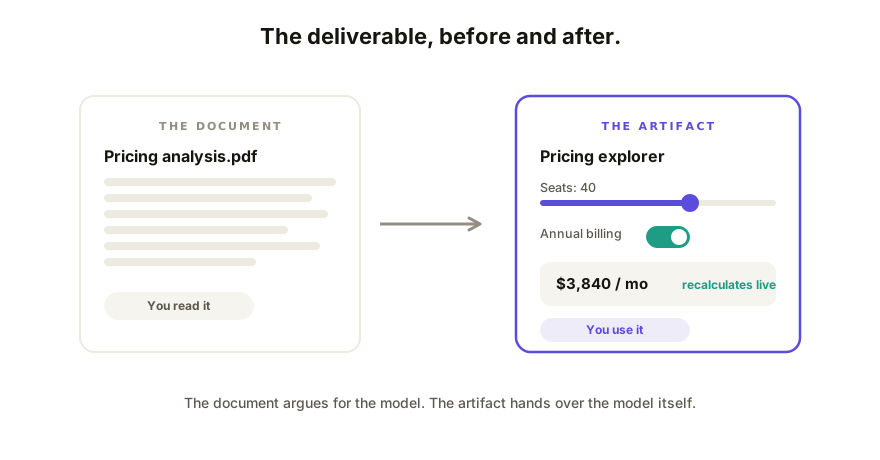
The unit of knowledge work is changing. For thirty years, the thing you handed over was a document: a page, a deck, a spreadsheet, something the recipient reads. AI collapsed the cost of making software, so the thing you hand over is increasingly an artifact: a calculator, a dashboard, a simulator, something the recipient uses. Documents describe; artifacts do. Most of our collaboration tooling was built for the describing kind.
What an artifact is
The word came into common use through AI tools (Claude calls its outputs artifacts; other tools say canvas or app, same thing underneath), but the idea is bigger than any tool's branding: an artifact is a small, working piece of software produced as a byproduct of thinking through a problem.
The key word is working. A pricing document lists three tiers and argues for them. A pricing artifact has sliders: move the seat count and watch revenue change. The document is an argument; the artifact is the argument plus the machinery, and the recipient can check the machinery themselves.
Why this is happening now
Nothing about interactive deliverables is new; what's new is who can afford them. Before, the ladder had a missing rung: anything interactive needed a developer, so knowledge workers stopped at documents and pasted screenshots of tools instead. AI removed the rung's cost: describing the calculator now is building the calculator (the file it arrives as). When making an artifact costs what making a document used to, people make artifacts, because artifacts win the comparison that matters: they answer the reader's next question, not just the first one.
A document anticipates questions and answers them in order. An artifact lets each reader interrogate the work: the CFO drags the discount slider, the ops lead filters to her region (the report version of this argument). One page, every reader's question.
What breaks when the unit changes
Every piece of the document workflow has an assumption baked in: the deliverable is static, and it's a file.
| Document-era habit | Where it breaks with artifacts |
|---|---|
| Email the file | An artifact's file breaks in transit or opens as code |
| Print / export to PDF | Freezes the interactivity, which was the point |
| Track changes in the app | Word can't render an app, let alone diff one |
| Comment in the margin | An artifact has no margin; feedback needs to pin to elements |
| "Final_v3" filenames | Artifacts iterate too fast; they need real version history |
This is why the shift feels bumpy in practice: people are producing the new unit with tooling built for the old one. The output upgraded; the handoff didn't.
The part that hasn't caught up
Documents got their collaboration layer: the browser-based office suite moved files to URLs, and sharing, commenting, and co-editing became properties of the format. Artifacts don't have that yet (the full stack-gap argument). Each AI tool holds its artifacts inside its own chat; between tools, and between maker and audience, the artifact travels like a 1990s attachment.
So the practical definition of "the shift" for a working team is: treat artifacts as first-class deliverables. Give them addresses, not attachments. Expect feedback on them, in them. Version them like the living things they are. The deeper history of how we got here is in the pillar essay.
How Coedit fits
Coedit exists to make artifacts first-class: it takes the working thing your AI produced (from Claude, ChatGPT, Gemini, Lovable, v0, or hand-written HTML) and gives it what documents already have: a live link anyone can open with no account, comments pinned to the element they're about, edits without code, and one version history across human and agent changes. It doesn't generate artifacts; it's the layer that makes yours usable by everyone who isn't you.
FAQ
Q: What is an artifact in the AI sense? A: A small, working piece of software an AI produces as the output of a request: a calculator, dashboard, planner, or prototype. Distinct from a document in that the recipient uses it rather than reads it. Under the hood it's almost always an HTML page.
Q: Are documents going away? A: No. Contracts, policies, and anything needing a frozen, signable record stay documents. The shift is in the default for analysis and communication work: where a document once described a thing, the thing itself is now cheap enough to hand over.
Q: Why can't I just manage artifacts like documents? A: The file habits break: attachments mangle interactive pages, PDFs freeze them, and document tools can't render, comment on, or version them. Artifacts need link-based sharing and element-level feedback.