TL;DR
For three decades, the output of knowledge work was a document, a spreadsheet, or a deck. AI quietly changed the default. When you ask Claude or ChatGPT for a pricing page, a dashboard, or a calculator, you don't get a description of one. You get the working thing. The catch: we have great tools for sharing and editing files together, and almost nothing for doing the same with a live app. That gap is the story.
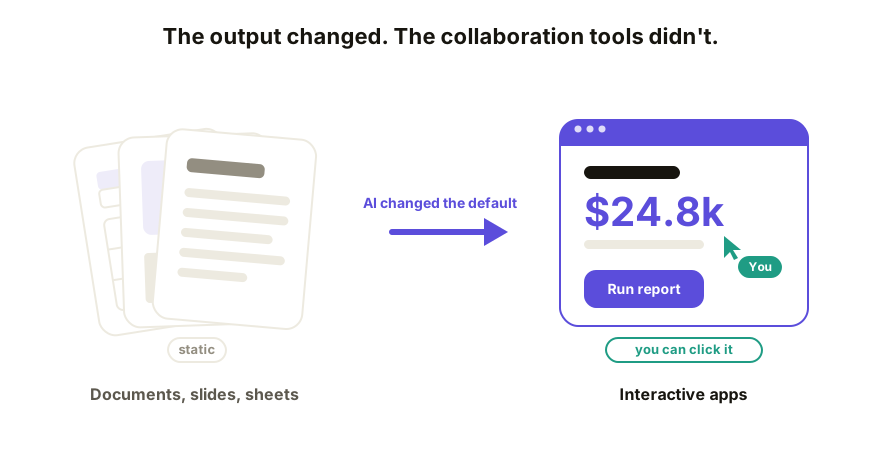
The output format changed when nobody was looking
Think about what you actually asked an AI tool for last month. A report. A planner. A little tool to compare two options. A landing page for an idea.
A few years ago, the answer would have come back as text you'd paste into a doc. Now it comes back as something you can click. Claude calls them artifacts. ChatGPT has canvas. Gemini builds small apps. Strip the branding and it's the same shift underneath: the unit of output went from a static file to a running interface.
This is a bigger deal than it sounds. A document is a description of an idea. An app is the idea, working. You don't read a description of the pricing calculator. You type a number in and watch it update. For most people, that's the first time they've been able to produce something interactive without hiring a developer or learning to code. The barrier that stood for thirty years just dropped.
We built an entire industry around the old format
Here's the part worth sitting with. Every collaboration tool you rely on was built for the old output.
Google Docs made text collaborative. Figma did it for design files. Notion, Excel, PowerPoint, DocuSign, every review-and-comment workflow your team runs: all of them assume the thing being worked on is a document. Comments attach to a paragraph. Version history tracks edits to a file. Sharing means sending a file or a link to one.
None of that machinery exists for a live app. When AI hands you a working dashboard, you can't drop a comment on the third chart. You can't let a teammate fix the headline without re-prompting the model. You can't see who changed what, or roll back to last Tuesday's version. The app is more capable than any document, and somehow you can do less with it.
So people fall back to the lowest common denominator: they screenshot it. A working, interactive thing gets flattened into a picture and pasted into Slack. That's the tell. When your best tool for collaboration is a screenshot, the tooling hasn't caught up to the output.
What people do instead, and why it's painful
A few patterns show up over and over once you start looking:
- You build something good, then send a screenshot because sending the actual file is awkward. The other person can't interact with the thing that made it worth sending.
- Someone gives feedback in a paragraph ("on the second section, can the button be bigger and the price lower"), and now you're the human middleman, translating prose back into the AI to make the change.
- Two people want to edit. There's no real way, so one person owns the file and everyone else suggests. The non-coders are locked out of changes as small as fixing a typo.
- A client needs to see it. Your only options are to flatten it to a PDF or to buy them a seat in whatever AI tool you used. Neither is good.
Every one of these was a solved problem for documents twenty years ago. They're unsolved for apps because the apps are new.
The missing layer
What's missing isn't another generator. The generation problem is, frankly, won: the models are very good and getting better, and there are a dozen tools racing to make building easier. Adding a thirteenth doesn't help anyone.
What's missing is everything that happens after something gets built: a link anyone can open without an account, comments that stick to a specific element, edits that non-coders can make directly, a history that survives both human and AI changes, and a way to do all of it at once without people overwriting each other. The collaboration layer. The part that turned static files from personal artifacts into shared work.
That layer has to be neutral to matter. People build with Claude one day and ChatGPT the next; an honest collaboration tool can't be locked to one of them, the same way Google Docs doesn't care which word processor typed the first draft. It works on the output, whatever made it.
How Coedit fits
This is the layer we're building. Coedit takes an app you already made (pasted in, or pushed straight from your AI tool) and turns it into a live link you can share, comment on, edit without code, and keep a full version history for, including the changes an agent makes. It doesn't generate anything. You keep making things wherever you already make them; Coedit is what lets you work on them with other people.
If you've ever screenshotted an AI-built page because sharing the real thing was too much hassle, that's the problem we started with.
FAQ
Q: Isn't a document still better for most work? A: For prose, often yes. But more and more of what people produce (dashboards, calculators, planners, proposals) is genuinely better as something you can interact with than as a paragraph describing it. The output is shifting because the better format finally got easy to make.
Q: Do I need to know how to code for any of this? A: No. The whole point of the shift is that AI removed the coding requirement to make interactive things. The collaboration layer should remove it for editing them too.
Q: How is this different from the AI tools adding sharing themselves? A: They're adding pieces, but locked to their own walls: their account, their org, view-only outside. The need is cross-tool and cross-company: sharing a Claude-built app with a client who will never log into Claude.