TL;DR
Price the deliverable's value to the client, not the hours the AI saved you. AI collapsed your cost of production; it didn't touch your value. And since anyone can generate a decent page now, the visible difference between cheap AI work and premium AI work is mostly delivery: how it arrives, opens, and takes feedback.
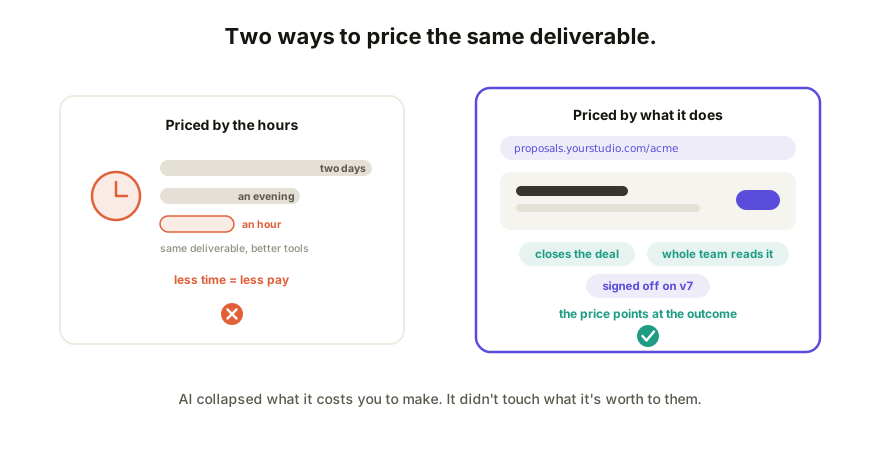
Why hourly billing punishes you for using AI
Hourly billing has one rule: you earn more when things take longer. That was always a little perverse, and AI turns it into a trap. The proposal that took you two days last year takes an evening now. The report build that filled a week fits into an afternoon. If you bill hours, every one of those improvements is a pay cut you handed yourself, and the trend only runs one way: the better your tools get, the less you'd earn for the same result.
There's a second problem. Clients can guess that generation is fast now. An hourly line item invites exactly the question you don't want on the table: "how long did this actually take?" That conversation is about your process. The conversation you want is about their outcome.
Price what it does, not what it took
A deliverable has a job, and the job has a value you can usually put a number on. Say you send an interactive proposal instead of a slide deck. A proposal exists to close a deal. If the interactive version closes one extra $8,000 project this quarter, it paid for itself many times over, and nobody involved cares whether it took you an hour or a week to build. Same logic for reporting: an interactive report the whole client team opens and pokes at beats a PDF nobody reads, because a report's entire job is to be read and acted on.
The practical move is to name the outcome in the line item. "Interactive proposal: live pricing the client can adjust, two feedback rounds, sign-off record. $1,500." Not "9 hours at $95." The first describes something they want. The second invites them to renegotiate the 9.
One sentence to keep in your head when you quote: the AI collapsed your cost, not your value.
Look worth it: the delivery signals that justify the price
Here's the uncomfortable part. Two freelancers can ship nearly the same AI-built page, and one invoice reads fair while the other reads inflated. The generated file is roughly the same everywhere now, so cheap versus premium is decided almost entirely between "done" and "delivered." These are the signals a client actually registers:
- It opens in one click. No download, no sign-in wall, no "which browser are you on." The first click is the first impression.
- It lives on your domain.
proposals.yourstudio.comreads like an operation. A generic tool URL reads like a subscription you happen to have. White-labeling is the difference. - It carries no third-party badge. A "made with" mark on a client deliverable quietly answers the pricing question for you, and not in your favor.
- Feedback happens on the page. Comments pinned to the exact element they're about, instead of a screenshot-and-email thread. Clients notice when giving feedback is easy.
- There's a version record. "Approved, v7" is a professional artifact. It closes the project cleanly and protects both sides when scope drifts.
None of these change what the AI generated. All of them change what the work appears to be worth, which at invoice time is the same thing.
Should you tell clients you used AI?
When they ask, yes, and without flinching. Frame it as your tooling, the same way a photographer names their camera. What the client is buying is your judgment about what to build, your taste in how it reads and behaves, and your name on the result when something needs fixing. The deliverable either holds up in front of their team or it doesn't, and no disclosure changes which one happened. If a contract or the client's own rules say something specific about AI use, follow them.
What you shouldn't do is volunteer a discount along with the answer. "Yes, I use Claude and v0, that's how I can promise this in a week at a fixed price" is a complete and confident sentence.
Productize it: fixed prices work when production is predictable
Fixed-price packages used to be risky because production time swung wildly; one messy project ate the margin on three clean ones. AI changed the variable that made them risky. When the build side is predictable, you can promise a price up front and keep it, which clients strongly prefer to an open meter. Three packages that work as productized offers:
- Client portal setup. One fixed price for a branded portal with links, status, and deliverables in one place. You don't need to code one anymore.
- Monthly interactive report. A recurring price for a live report page, updated on schedule, feedback handled on the page.
- Proposal system. A setup fee for the template plus a small per-proposal price. The fifth proposal costs you an hour and the client the same money as the first.
The end-to-end delivery workflow is what makes this repeatable enough to put a fixed number on: build with any tool, publish to one link, run feedback and sign-off in the same place every time.
How Coedit fits
The delivery signals above are the product. Paste in what any AI tool built (Claude, ChatGPT, Gemini, Lovable, v0, or hand-written HTML) and it goes out as one live link that opens with no account on the client's side, takes comments pinned to the element they're about, and keeps version history so sign-off points at a specific version. Pro, at $12 per editor per month, puts deliverables on your own domain with no badge and adds private and password-protected links. It's priced under an AI subscription on purpose: it's the layer that makes the AI subscription billable. Coedit never generates anything. It makes what you built look worth what you charged.
FAQ
Q: Should I charge less because AI did most of the work? A: No. The client is paying for the outcome and for your judgment, not for your effort. Your production cost dropped; the deliverable's value to them didn't. Pricing by your costs was always the weaker frame, and AI just made that obvious.
Q: What if a client asks how long it took? A: Answer honestly, then move the conversation back to what the deliverable does: what it closes, who reads it, what it replaced. Speed is a feature of your service. Under value pricing it's a selling point, not a confession.
Q: How do I justify a fixed price when the client knows AI is fast? A: Because they're not buying generation, they're buying a finished, delivered, signed-off result. The fixed price covers the judgment, the revisions, the delivery on your domain, and the accountability. Fast production is the reason you can offer a fixed price at all.
Q: How do I move an existing hourly client to fixed prices? A: Package one deliverable they already buy, like the monthly report, at a fixed price slightly above what it averaged hourly, and keep the rest hourly for now. They get cost certainty, you get paid for your tools, and the next package is an easier sell.