TL;DR
AI didn't remove your agency's bottleneck, it moved it. Production that took a week now takes an hour, and the constraint is the review gate before anything reaches a client. The fix: publish each draft to an internal live link, let seniors comment and fix it on the page together, and mark approval with a named version before the client gets their own link.
The bottleneck moved, and it moved to you
For twenty years the agency pipeline was shaped like a funnel: production was slow and expensive, so a handful of deliverables trickled toward review and a senior could eyeball each one over coffee. AI inverted that. A junior with Claude, ChatGPT, or v0 can now produce in an hour what used to take a week, and they do, all day.
That's not a problem, it's the point. The problem is that your review process was built for the trickle. When six drafts land before lunch, "Slack me the link and I'll take a look" stops being a process and becomes a queue with your most expensive people at the bottom of it. Volume went up tenfold; scrutiny didn't. And the client only ever sees the output of the gate, never the speed behind it. One sloppy AI-built page in a client's inbox costs more trust than fifty fast ones earn.
So the question isn't "how do we produce more with AI." You've solved that. It's "how do we review at the speed we now produce."
Why reviewing inside the generation tool fails
The reflex is to review where the work was made: the junior shares their Claude artifact or v0 preview and asks for notes. Three things break immediately.
- It's locked to one person's account. The draft lives inside the junior's chat history. The reviewer either can't open it at all or sees it through a shared login, and nobody else on the team can look at the same thing at the same time.
- There's no shared markup. Feedback becomes a Slack thread of "the third card, no, the other third card" next to a screenshot. Nothing pins to the element it's about, so half the review is spent establishing what the review is about.
- There's no record. Chat history isn't an audit trail. When the client asks what changed since Tuesday, or a reviewer asks whether their note was addressed, the answer lives in someone's scrollback, if it lives anywhere.
Generation tools are exactly that: tools for generating. They were never built to be the room where five people inspect the work. The review needs to happen on the live page itself, somewhere everyone can stand at once. (If your team hasn't made that jump yet, start with turning an AI prototype into a team review.)
The review gate, step by step
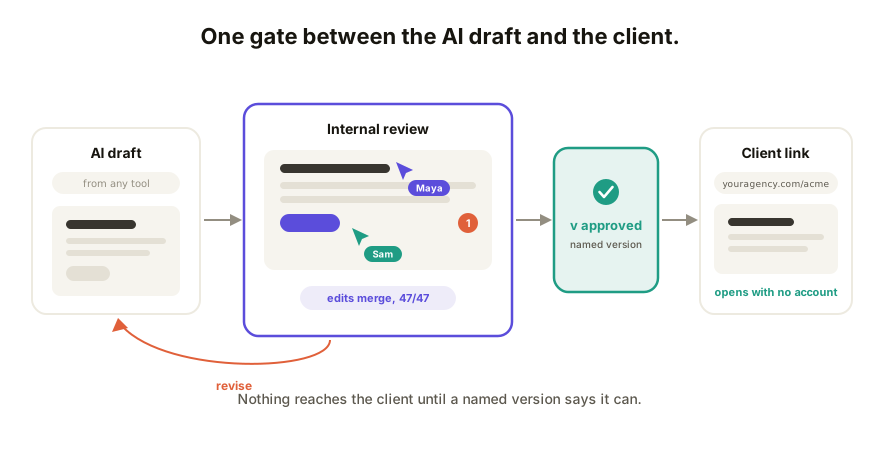
- Publish the draft to an internal link. Whoever built it pastes the HTML into a collaboration layer, or publishes straight from the agent via CLI or MCP, and drops one URL in the project channel. Everyone opens the same live page. No accounts needed to view or comment, so nobody's blocked on an invite.
- Seniors mark it up on the page, together. Comments pin to the exact element they're about: this button, that headline. Copy and style fixes don't need a ticket; reviewers make them directly on the live page, with everyone's cursor visible. Concurrent edits merge instead of overwriting each other, verified by 47/47 concurrency tests, because the page is a CRDT document underneath. Two seniors polishing the same section at once is normal, not a hazard.
- Bigger changes loop back through the AI tool. Layout rethinks and logic changes go back to whichever tool built the draft. The junior regenerates and republishes to the same link, so the review picks up where it left off instead of starting a new thread.
- Approval is a named version. When the work passes, the lead names the version: "Approved for Acme, round 1." That's the gate. It's not a thumbs-up emoji that scrolls away; it's a snapshot you can reopen, compare, and roll back to.
- The client gets their own link. Only now does anything leave the building. The client opens it in one click, no account, and their feedback lands on the live page the same way your team's did, in a clean thread that starts from the approved version.
Agent edits ride the same rails. When an AI agent proposes changes to a published page, they arrive as suggestions a human approves, not silent overwrites. The gate applies to the machines too.
Sign-off that survives the project
Every agency has lived the "which version did they approve?" argument. Under this workflow the question answers itself: sign-off is a named version in the history that spans human and agent edits, timestamped, diffable, and restorable. When scope creeps or memories differ three weeks later, you point at the version, not at a recollection of a call. That record is worth more to a small agency than any speed gain, because it's the thing that ends disputes instead of starting them.
How Coedit fits
Coedit is the room this workflow happens in. It doesn't generate anything, and it doesn't care which tool did: Claude, ChatGPT, Gemini, Lovable, v0, or hand-written HTML all publish to the same live link. Reviewers comment pinned to elements and co-edit the page with per-person cursors, agent edits wait as suggestions until a human approves them, and named versions plus rollback make the approval gate real. Pro at $12 per editor a month puts client links on your own domain with no badge and adds private links. Team at $20 per editor a month adds what an agency running many hands through one gate needs: SSO, roles, admin with an audit log, and a shared library.
FAQ
Q: How do we review AI-generated work before it goes to a client? A: Publish each draft to an internal live link, have reviewers comment pinned to specific elements and fix copy and style directly on the page, send structural changes back through the AI tool, and mark approval with a named version. The client only ever sees links cut from an approved version.
Q: What happens when two reviewers edit the page at the same time? A: Their edits merge. The page is a CRDT document, so concurrent changes combine instead of one overwriting the other, verified by 47/47 concurrency tests. Reviewers see each other's cursors live, so simultaneous polish is the normal case, not a conflict.
Q: Do we need the Team plan for this, or is Pro enough? A: Pro at $12 per editor a month covers the client-facing side: your own domain, no badge, private links. Team at $20 per editor a month is built for the internal gate at agency scale: SSO, roles, admin with an audit log, and a shared library the whole team pulls from. A two-person studio can run this on Pro; a team with juniors producing daily usually wants Team's roles and audit trail.
Q: How do we prove which version the client approved? A: Name the version at sign-off ("Approved for Acme, round 1") and it becomes a permanent, timestamped snapshot in version history. You can reopen it, diff it against what shipped later, and roll back to it. The approval is an artifact, not a memory.