TL;DR
The best thing your AI ever made for you is probably sitting in a chat thread you can't quite find anymore. Not because it wasn't good, but because a conversation is a terrible place for finished work to live: it's single-player, unsearchable by anyone but you, and invisible to the people the work was for. Output that stays in the chat has a lifespan of about one scroll.
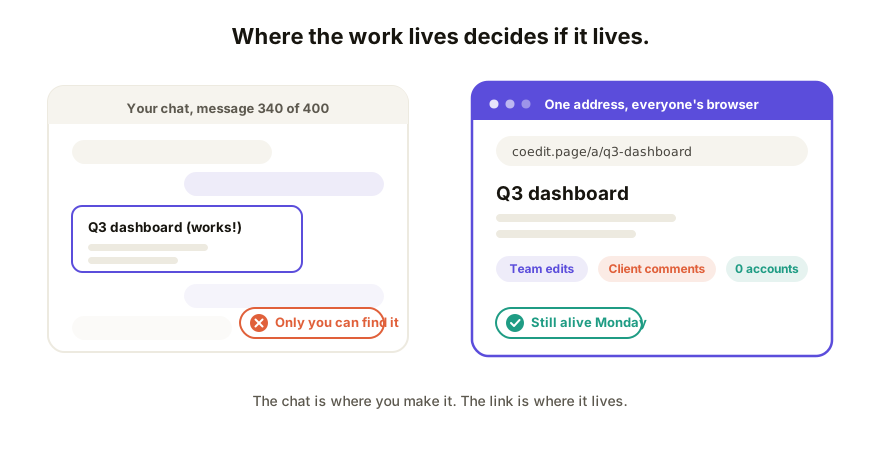
The pattern, and why it repeats
It goes like this. You spend an evening with Claude or ChatGPT building something real: a pricing calculator, a project dashboard, an interactive report. It works. You're a little proud of it.
Then Monday happens. The thing your team actually sees is a screenshot of it in Slack, or a paragraph describing it, or nothing at all, because the working version lives in your chat history, behind your account, four hundred messages deep in a thread called "Untitled".
This isn't a discipline problem. It repeats because chat is the wrong shape for output, in three specific ways.
1. A conversation is single-player
Your chat is yours. The model's memory of the project is attached to your account, your thread, your context. The moment a second person matters (a teammate who needs to use the dashboard, a client who needs to react to the proposal), they hit a wall: they can't open your conversation, and if the tool lets you share it, what they get is a transcript to read, not a thing to use.
Compare that to what happened to documents. A Word file emailed around was single-player too; Google Docs' whole trick was moving the document to a URL where everyone touches one copy. AI chat is pre-2004 in this respect: the work is wherever the conversation happened.
2. A conversation buries its own results
Chat is chronological, and chronology is a terrible filing system. The finished artifact sits at message 340 of a thread that also contains four abandoned drafts, a tangent about fonts, and the prompt where you changed your mind. A week later, even you struggle to find the good version. Two months later, it's effectively gone: not deleted, just unfindable, which lands the same.
Work that matters needs an address: a stable place one link can point to. "Somewhere in my chats" is not an address.
3. A conversation can't accept feedback
Say you beat problems one and two: you export the thing, or send the tool's share link. Now your reviewer is looking at it. Where does their reaction go?
Back into chat, of course, but your chat with them: "looks great, can the summary go on top?" And you become the relay: you carry their words back to the AI, re-prompt, re-export, re-send. Every round of feedback costs a full lap through you. The feedback never touches the work; it just orbits it. We wrote about the ladder of alternatives in the best ways to share AI-generated apps; the short version is that most of them stop exactly here.
What the work actually needs
Not a better chat. Finished output needs what documents got twenty years ago, adjusted for the fact that this output is interactive:
- An address. One stable link, not a location inside someone's account.
- An open door. Anyone with the link can open it, on any device, with zero accounts.
- A way to respond in place. Comments that pin to the element they're about, not paraphrases in a side channel.
- A way to change it without starting over. Edits by people who don't code, with a history that survives them.
That set of properties is a collaboration layer, and it's the missing piece between "the AI made something great" and "the team actually uses it." The bigger argument for why this is the decade's document-to-app shift is in the pillar essay.
How Coedit fits
Coedit is where the output goes when it leaves the chat. Paste the HTML your AI handed you (any AI: Claude, ChatGPT, Gemini, Lovable, v0) and it becomes a live link with an address, no-account viewing and commenting, no-code editing, and one version history across human and agent changes. The chat stays what it's good at: the place you make things. The link becomes the place your work lives.
FAQ
Q: Why can't I just share my ChatGPT or Claude conversation? A: You can, and for showing your process it's fine. But a shared conversation is a read-only transcript: the recipient reads about the work instead of using it, can't comment on a specific part, and your link goes stale as you keep iterating.
Q: Isn't exporting the file enough to get work out of the chat? A: It gets the work out of the chat and onto your laptop, which is a different trap. Files sent as attachments open unreliably and fork into stale copies. The work needs a live address, not a loose copy. See how to share an HTML file.
Q: Does this problem go away as AI tools add sharing features? A: Vendor share links keep improving, but they stay tied to the vendor's accounts and domain, and only work for that vendor's output. Teams use several AI tools at once, so the shared home for the output has to be neutral ground.