TL;DR
Use a Claude artifact whenever the work is between you and Claude: prototyping an idea, building a personal tool, exploring your own data, drafting a page. Move the work out the moment it's between you and other people: client deliverables, feedback rounds, shared editing, anything living on your domain. Artifacts are a making surface, not a collaborating surface, and knowing that line saves you from fighting the tool.
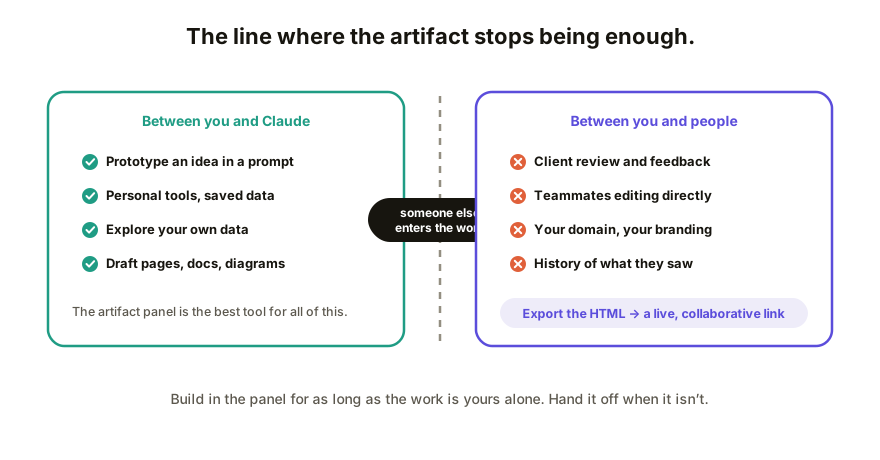
Where artifacts are genuinely great
Not faint praise: for the single-player half of the work, artifacts are the best surface any AI tool ships.
- Zero-setup prototyping. Idea to working page in one prompt, iterated by conversation. Nothing else gets you from "what if the pricing page had a slider" to a clickable answer faster.
- Personal tools that keep data. Artifacts can now save up to 20 MB between visits, so a habit tracker or reading log you actually return to is a real option, no hosting involved.
- Seeing your own data. Paste a CSV, ask for an interactive chart, drag the filters around. As a private analysis scratchpad it beats fighting a spreadsheet.
- AI-powered mini apps. Artifacts can call Claude from inside the page: flashcards that generate themselves, a form that critiques what you type. Genuinely new territory.
- A quick "look at this" for people already in Claude. Share the link or invite by email, and they can view, comment or edit. For show-and-tell inside your team, done in thirty seconds.
The shared thread: one person, in a loop with Claude, making a thing.
The pattern behind the walls
For the single-player half, the artifact limitation is one limitation wearing different clothes: everything routes through your chat. Edits happen by you re-prompting. Versions live in your conversation. Until September 2026 the published link was a window into your work, not a workspace. It's more than that now: new artifacts have view, comment and edit roles. But the people have to be signed in to Claude, the link is on Claude's domain, and copies made by others are still separate copies. For a legacy published artifact, saved data hangs off it: unpublish it and your visitors' data goes with it.
The September 16, 2026 change added comment and edit roles, so several signed-in people can now work on one artifact. The line this post is about just moved: the moment the person who needs in is a client with no Claude account, or someone on a different AI tool, you're back outside the wall.
That design is exactly right for making. It's exactly wrong for the moment someone outside your org needs to do more than look.
When an artifact is the wrong tool
| You need | Why the artifact fights you | The move |
|---|---|---|
| A client deliverable with your name on it | A link on Claude's domain that needs a Claude sign-in | Your own domain, your branding |
| Feedback from stakeholders with no Claude account | Commenting needs a Claude sign-in; their reactions arrive as prose in Slack | Comments pinned to the live page |
| A client or outside reviewer fixing copy or styling | Editing needs a Claude account; for anyone else, copies fork and real edits route through you | No-code editing on a shared surface, no seat required |
| A real backend or outside services | The sandbox blocks external calls; storage caps at 20 MB | Actual hosting and development tools |
| One workflow across Claude, ChatGPT, Gemini | Artifacts are Claude's container only | A tool-agnostic layer |
| A record of what the client saw when | Versions live in your chat, not on the shared thing | Version history on the shared link itself |
Notice what's not on the list: "the app is too ambitious." Capability is rarely the wall people hit first. Collaboration is.
The handoff, in practice
You don't have to choose one tool. The workable pattern is a handoff:
- Build and iterate in Claude for as long as the work is yours alone. This is what artifacts are for.
- When someone else enters, export the HTML. It's a plain web page; it's yours. Ask Claude for it as a single file if you don't see a download option.
- Give it a home built for people: a live link where they can view, comment, and edit without touching your Claude account, and where updates don't mean re-sending anything.
The mistake isn't building in Claude. It's staying in the artifact panel through review week, relaying "she said make the header shorter" into prompts by hand.
How Coedit fits
Coedit is the surface on the far side of that handoff. Paste the artifact's HTML and it becomes a live link where viewers and commenters need zero accounts, teammates edit copy and design without code, and every change (human or agent) lands in one version history you can roll back. The merge engine behind the shared editing passes 47/47 concurrency tests, and the same flow works whether the page came from Claude, ChatGPT, Gemini, v0, Lovable, or your own hands. Claude stays the builder. Coedit is where the work meets people.
FAQ
Q: Can a client use my Claude artifact without an account? A: Not for a new artifact. Since September 16, 2026, "anyone with the link" means anyone signed in to Claude, and invited outsiders need a Claude account. Legacy artifacts (made before that date) that were published still open with no account.
Q: Can two people work on the same artifact? A: Yes, with the Can edit role, as long as they're signed in to Claude. A copy someone makes themselves stays separate and your original never changes. Someone with no Claude account still can't join, so it doesn't cover a client or an outside reviewer (the full breakdown is here).
Q: Artifacts store data now. Doesn't that make them real apps? A: It makes them real personal apps. The 20 MB per-artifact store is great for trackers and journals, but it's tied to your published artifact (unpublishing deletes it) and it isn't a substitute for a database, user accounts, or external services.
Q: Should I stop building client work in Claude? A: No, build there; it's the fast part. Just don't deliver there. Export the HTML and hand the client a link that takes comments, holds version history, and can carry your domain instead of Claude's.